Executive Summary
Most industrial businesses compete on what they have. More fleet. More locations. Bigger catalogue. The assumption runs deep: scale is the moat.
Ashtead Group, operating under the Sunbelt Rentals brand across North America and the UK, chose a different bet. They decided that how intelligently you run what you have matters more than how much you own. That shift, executed over several strategic iterations, has turned a rental company into something closer to a logistics platform. The machines are still the product. But the system behind the machines is the real asset.
The result is a business generating $10.3 billion in annual rental revenue in fiscal 2026, a record $2.1 billion in free cash flow, and a rental fleet valued at roughly $19 billion at original cost. Not because they out-purchased competitors, but because they out-operated them.
For SME leaders in physical goods and industrial services, the Ashtead story is not a size story. It is a systems story. And the lesson translates directly.
1. What Ashtead Actually Does
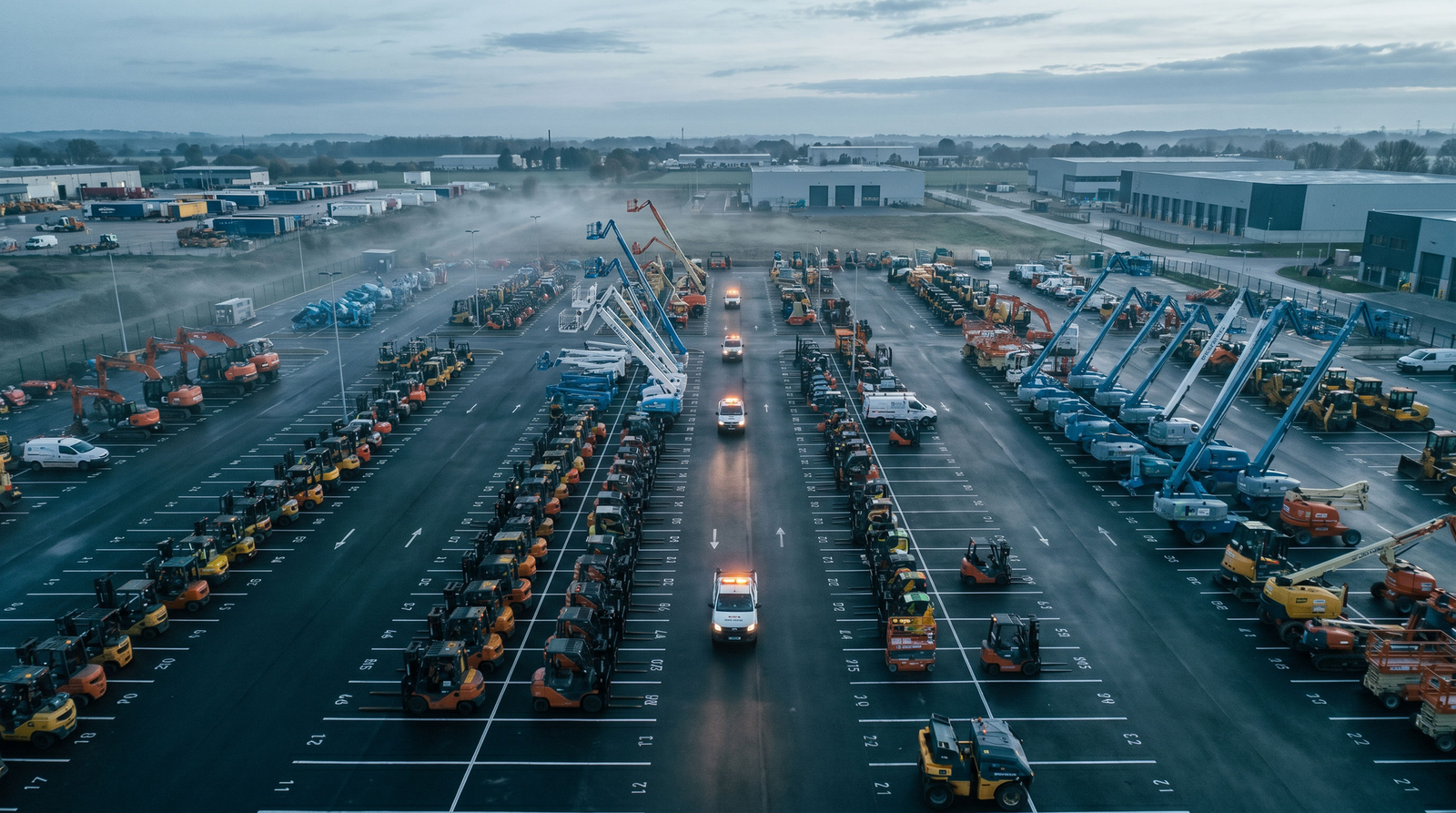
Ashtead Group is one of the world's largest equipment rental businesses. Through Sunbelt Rentals, they put forklifts, earth-moving machinery, HVAC systems, power units, scaffolding, and specialist gear into the hands of construction firms, industrial operators, and project managers, without those customers having to own any of it.
The value proposition is straightforward: rent instead of buy, and you keep capital free, stay flexible, and hand the maintenance burden to someone else. Sunbelt is that someone else.
In the US, their biggest market, Sunbelt holds roughly 11% market share and operates around 1,430 stores, part of a network of more than 1,600 across North America and the UK. In Canada and the UK, the footprint continues to grow. The completed redomiciliation, the group's primary listing moved from London to the New York Stock Exchange, where it has traded as SUNB since March 2026, signals where the center of gravity now sits. This is a North American growth story, wearing a British parent's jersey.
Their core customer isn't a startup or a retail buyer. It's an operator managing a multimillion-dollar construction project, an industrial site running on tight margins, or a project manager who cannot afford a broken machine on day three of a six-week schedule. These customers don't rent equipment for convenience. They rent it because downtime is catastrophic.
That single customer truth, that what they are really buying is reliability and not assets, shaped everything Ashtead built next.
2. The Turn: From Fleet to Platform
For most of the last decade, Ashtead grew the obvious way. Under the banner it called Sunbelt 3.0, it expanded branch clusters, pushed into higher-margin specialty lines, and moved faster than the market. It worked: the business roughly doubled, specialty rentals compounded at more than 25% a year, and the model rewarded aggression.
But management could see the ceiling. Growth by branch count and truck count is replicable. A competitor with capital can also open locations and buy fleet, and share won by expansion can be lost to a better price or a closer depot. Scale, on its own, is not a moat.
So the next chapter, which Ashtead calls Sunbelt 4.0 and runs to 2029, was not a bigger version of the same plan. It was a decision to make growth harder to copy. Instead of only adding fleet and footprint, Ashtead built a digital and operational backbone around them: technology to price and allocate equipment in real time, logistics that treat a whole metro area as one network rather than a set of individual branches, and service processes designed to keep each machine earning for more days a year.
That is the move that redefined what Ashtead sells. The machine is still the product. But the platform around it, the logistics layer, the data, the customer interface, is the competitive position, and it is the part a rival cannot stand up in a quarter. The investment is enormous and the lead time is measured in years.
3. The Blueprint: How Ashtead Executes
Ashtead's execution model rests on three reinforcing levers. Each one is deliberate. None of them work in isolation.
A. Building Customer Value on Reliability
Customers don't rent a forklift to have a forklift. They rent it to keep a project on schedule.
A late delivery or a broken unit on a major construction site doesn't just cause inconvenience. It stalls a multimillion-dollar operation. Every hour of downtime has a number attached to it, and that number is almost always large. Customers know this. It's the reason they evaluate rental companies not on price first, but on whether they can be trusted to deliver, every time.
Ashtead redesigned the customer experience around that insight.
Online portals and dynamic pricing give customers instant transparency, real-time availability, honest pricing, no back-and-forth phone calls to find out whether a unit is free. That saves time. More importantly, it builds confidence that the pricing is fair and the information is accurate.
The Connect360 platform goes further. It tracks usage, fuel levels, and equipment location in real time, sending proactive alerts before a problem becomes a failure. Customers don't just get a machine. They get visibility into that machine throughout the rental period. Sunbelt knows before the customer does if something is going wrong.
Operator's Takeaway: Customers will pay more for certainty than for assets. Reliability is pricing power.
B. Redesigning Operations, Not Just Digitising Them
The same systems that improve customer experience also make the underlying operation leaner. This is not a coincidence. It's the point.
Ashtead didn't bolt technology onto an existing process. They used technology as a reason to rebuild the process.
The most visible example: market-level logistics. In a traditional branch model, each location dispatches its own trucks, manages its own fleet, and handles its own scheduling. Inefficiency is baked in: a truck sitting idle in one branch while another branch three miles away needs it urgently.
Ashtead changed the unit of operation from the branch to the metro area. Trucks, drivers, and fleet move across entire cities based on where demand actually is. Asset utilisation goes up. Idle time goes down. The branch is still the customer touchpoint, but the logistics run above it.
Repair hubs follow the same logic. Instead of every branch attempting to fix every kind of equipment, stretching technician capability and clogging the system, Ashtead built specialised repair centres. Quick-turnaround machines get processed fast. Complex repairs get the focused attention they require, at a facility designed for that work. The result is more machines back in service, faster.
Operator's Takeaway: Efficiency is not about cutting people. It's about redesigning workflows so assets move faster and generate more revenue days.
C. Reinvesting Surplus With Intent
This is where most companies stop. They capture the efficiency gain, and it flows to margin.
Ashtead treats it differently. The surplus is fuel.
With returns on invested capital well ahead of its cost of capital, Ashtead has been funding 300 to 400 new branch openings and a multi-billion dollar expansion into specialty services, HVAC, power, barriers, and other high-margin rental categories that general equipment companies don't serve well. The pattern continued in May 2026 with the $650 million acquisition of Reliant Asset Management, Sunbelt's thirteenth specialty line, and its entry into the roughly $20 billion modular-solutions market.
This is the critical discipline. Operational redesign generates surplus. That surplus gets reinvested into the next growth layer. The system grows itself.
The growth is not financed by excessive debt. It is generated by the compounding returns of a well-run operation. That is a structurally different and structurally superior position to a competitor who needs to borrow every time they want to grow.
Operator's Takeaway: Savings are fuel. The discipline is knowing where to direct them.
4. The Flywheel
Here is what makes the Ashtead model genuinely durable. Each move in the system feeds the next.
- Better customer experience, reliability, transparency, Connect360 alerts →
- More loyalty and willingness to pay, customers stay, premium holds →
- Surplus captured, higher ROIC, stronger free cash flow →
- Reinvestment into logistics, repair infrastructure, specialty, the system improves →
- Lower costs, higher asset utilisation, fewer idle days →
- Back to (1), the customer experience gets even better.
A simple loop. But one that compounds year after year.
The competitive danger of a flywheel like this is not that competitors can't see it. They can. The danger is that by the time they try to build one, the lead is too large to close.
The Latest Print: Fiscal 2026
The most recent numbers tell the story in miniature. In its fiscal year to 30 April 2026, Sunbelt grew rental revenue to $10.3 billion and generated record free cash flow of $2.1 billion, up 23%. Yet adjusted operating profit slipped and the adjusted EBITDA margin fell to 41.9%, down 210 basis points, as softer US non-residential construction and fleet repositioning weighed on the general-tool business.
Revenue and cash flow up, margins down: that is the operating model earning its keep against a soft cycle. The parts that are hardest to copy (specialty, still growing faster than general tool; services; and the platform underneath) kept advancing, and management guided to 5 to 8% rental growth for fiscal 2027. The machines felt the cycle. The system absorbed it.
5. Lessons for SME Leaders
The Ashtead story is extreme in scale. The principles behind it are not.
1. Think in systems, not tools. Adopting software is not a strategy. Integrating technology across the full workflow, so that every part of the operation generates and uses information, is a different undertaking entirely. The question is not "which tool should we buy?" It is "which process should we rebuild, and what does technology make possible when we do?"
2. Redesign, don't digitise. Bolt-on tools automate old problems. They don't solve them. If your delivery process is inefficient, a tracking app makes the inefficiency visible. It doesn't fix the underlying design. The operators who win over the next decade will be the ones who used the tools as a reason to redesign the process, not just speed up the existing one.
3. Reinvest with intent. Most SME leaders reinvest reactively: when something breaks, when a competitor moves, when the bank allows it. The discipline of deciding in advance where efficiency gains go, and ring-fencing them for the next growth cycle, is rare. It's also one of the clearest separators between businesses that compound and businesses that plateau.
4. Reliability is the moat. In industrial B2B, trust is not a soft concept. It is a commercial one. A customer who knows you will deliver, every time, will pay more for that certainty and will not leave easily. In most physical goods markets, reliability is both underdelivered and underpriced. That is an opportunity, not a given.
5. The system is the asset, not the inventory. Ashtead's real asset is not a $19 billion fleet. It is the system that makes that fleet more productive than a competitor with the same machines. In your business, whatever you make, move, or service, the same principle applies. Your process, your logistics, your customer interface, your information flow: those are where lasting advantage accumulates.
6. Conclusion
Ashtead didn't win by owning more. They won by building a system that makes everything they own work harder, stay in service longer, and deliver a better outcome for the customer at every step.
Their shift from branch-by-branch rental to platform-driven operator is a clear illustration of how industrial leaders build durable positions in markets that reward reliability over raw scale.
For SME leaders in physical goods, logistics, and industrial services, the honest question is this: are you competing in today's market with yesterday's operating model, or are you building the kind of system that makes you the default choice tomorrow?
The companies that answer that question now have a window. It won't stay open indefinitely.
Items to Monitor
Testable claims from this read, to be re-rated as new prints land:
- Specialty mix. Specialty rental keeps outgrowing general tool, and the new Reliant modular line scales toward a visible share of specialty revenue. (Watch: fiscal 2027 quarterly prints.)
- Margin recovery. The adjusted EBITDA margin stabilises or recovers from 41.9% as fleet repositioning normalises and US construction firms. (Watch: through fiscal 2027.)
- Reinvestment discipline. Bolt-on M&A stays at disciplined multiples and greenfield openings track the 300–400 Sunbelt 4.0 target without leaning on debt. (Watch: capital-allocation disclosures.)
Sources
- Sunbelt Rentals Holdings, Fiscal Fourth Quarter and Full-Year 2026 Results, 23 June 2026.
- Sunbelt Rentals Holdings, Annual Report (Form 10-K), fiscal year ended 30 April 2026.
- Ashtead Group, Half-Year 2026 Results, 9 December 2025.
Altered.Works explores how physical goods businesses build durable advantage in a world that increasingly rewards intelligence over inventory. This analysis is part of the ongoing series behind The Industrial Reset.